
Protecting election workers
Elections Canada (EC) worked with federal, provincial and territorial public health authorities to develop several health and safety measures for all of its local offices and polling places. These measures protected not only electors, but all office staff and poll workers hired for the election. Furthermore, EC created a new staffing and training model to ensure the safety of election workers.
Health and safety measures
COVID-19 health guides
EC developed COVID-19 health guides for election administrators and poll workers to ensure the safety of electors and staff at polling places and offices of returning officers and additional assistant returning officers.
These guides outline basic on-site health and safety measures for staff and visitors at polling places during the election. They include information about how EC enforced and encouraged the respect for these public health measures. All poll workers had to read and be familiar with the contents of the guides.
Other guidelines for electors, such as mandatory masks, were enforced based on provincial or municipal guidelines.
Personal protective equipment
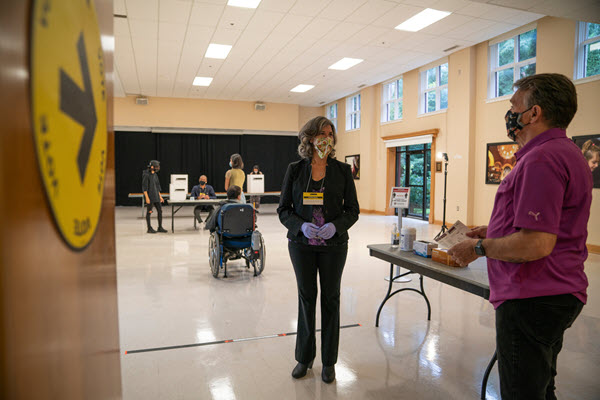 Poll workers were given disposable face masks at each polling place. All poll workers, candidates and candidate representatives at polling places were required to wear masks.
Transparent face shields were provided and recommended for use by all poll workers who were not sitting at a desk with a transparent physical barrier—especially if they were interacting face-to-face with visitors and/or were unable to maintain physical distancing. Masks still had to be worn under the face shields.
Gloves were provided, especially to poll workers who were disinfecting commonly touched surfaces. Some poll workers wore gloves during the counting of ballots. Finally, transparent non-medical face masks were available.
Central poll supervisors were responsible for making sure that poll workers used personal protective equipment properly.
New training model
As it was not always possible to safely conduct classroom training for the 44th general election, EC developed additional training formats for poll workers in order to comply with public health measures and meet the needs and expectations of trainees and trainers.
Four training formats were available:
- Classroom training: This was the default format, as it is the most reliable and well-understood. To protect election workers, learners were seated individually and physically distanced and they had to wear a mask.
- Remote training: This format involved an online session (videoconference) that was led by one or more training officers. Learners viewed the classroom presentation and used the same classroom kits as those used in the classroom setting.
- Training workbook: This format involved using a physical workbook that contained the same information and met the same learning objectives as those of the classroom training session. The workbook presented information in a playful and engaging manner to make it appealing to learners. It was used with a copy of the relevant guidebook and contained everything learners needed, including cut-out materials, to practice their role at their own pace. After completing the workbook, learners had a follow-up conversation with the local training officer to verify their understanding of the material and get answers to any questions.
- Online training: This format consisted of an e-learning course hosted on EC’s Virtual Training Centre.
All of the above formats are derived from the same training curriculum and support the same learning objectives.
To learn more, please consult: Training material for poll workers – Elections Canada.
New staffing model
 To ensure health and safety at the polls and reduce recruitment needs, a single poll worker was completing all voting procedures. Indeed, the poll clerk position was eliminated and its duties were redistributed among other poll worker positions. This eliminated the need for two poll workers to sit side by side all day long.