
Adapting voting operations
Voting by mail
Canadians have been able to vote by mail, using the special ballot process, since 1993. In the context of the COVID-19 pandemic, Elections Canada expected a significant increase in requests to vote by mail during the 44th general election. The Chief Electoral Officer of Canada issued specific instructions in order to meet the anticipated demand and facilitate the vote by special ballot for local electors, which are electors voting by special ballot from within their riding. Elections Canada adapted its procedures accordingly.
Applications for registration and special ballot
To manage the increase in requests to vote by mail due to the pandemic, Elections Canada developed an online application system for electors applying to vote by mail from within their riding. Before the 44th general election, this online service was only available for electors living outside Canada, or applying to vote from outside their riding.
Electors still had the option to apply to vote by mail by contacting an Elections Canada office. Application forms were also available at select Canada Post locations in communities identified as having limited Internet connectivity and located far from the nearest Elections Canada office.
Electors had until Tuesday, September 14, 6:00 p.m., to apply to vote by mail.
Checking application status
Elections Canada reviews applications to vote by mail within 72 hours of receiving them.
During the 44th general election, electors who applied online to vote by mail could check the status of their application on Elections Canada's website using the reference number they were given when they applied.
Filling out and returning the special ballot

Once an elector's application to vote by mail is accepted, Elections Canada sends them a special ballot voting kit by regular mail or hands a kit directly to the elector if they applied in person.
The kit contains a special ballot; a blank white inner envelope; an outer envelope with the elector's name and riding and a space where they sign a declaration; a pre-addressed return envelope with prepaid postage; and voting instructions.
Special ballots do not have a list of candidates to choose from. Instead, there is a blank space where the elector writes the name of the candidate they are voting for. Electors can consult the list of confirmed candidates for their riding online. The voting kit includes instructions on how to fill out and return the special ballot.
For the 44th general election, electors had until election day (Monday, September 20) to return their ballot.
Pre-addressed return envelope with prepaid postage
This general election was the first time Elections Canada offered return envelopes with prepaid postage for special ballot voting kits. Each kit contained one of these envelopes, and electors therefore did not need to add a stamp when mailing back their ballot.
For their vote to be counted, electors voting by mail had to make sure that their completed special ballot kit arrived at the address specified in their voting kit by election day.
Special ballot drop off
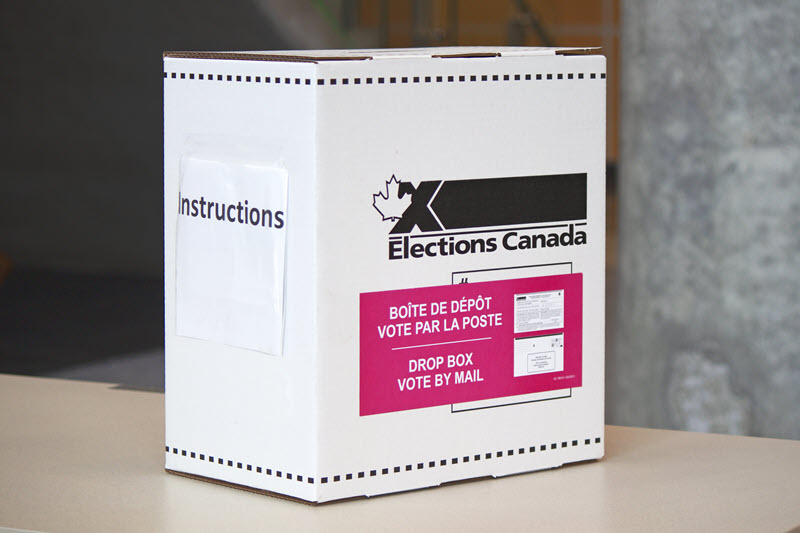
To make sure their special ballot kits were received in time, Elections Canada allowed electors who applied to vote by special ballot from within their riding to drop off their completed kit at their assigned polling place—or any polling place in their riding—on election day.
Electors also had the option to drop off their voting kits at their local Elections Canada office anytime during the election.
To be counted, completed ballots had to be dropped off by the close of the polls on election day (Monday, September 20).
Ballot tracking
During the 44th general election, electors could check online—using the reference number they were given when they submitted their application—if Elections Canada had received their completed special ballot kit. They could also call Elections Canada to check the status of their returned ballot.
Voting by regular ballot
Once an elector's application to vote by mail is approved by Elections Canada, they can't change their mind and vote at advance polls or on election day.
However, for the 44th general election, the Chief Electoral Officer of Canada instructed returning officers to allow—under certain circumstances—electors who had applied to vote by mail (i.e. by special ballot) to vote by regular ballot on election day.
Electors who had applied to vote by mail and showed up at their polling place on election day could complete a certificate that cancelled their special ballot request and allowed them to vote by regular ballot instead if:
- their name was struck from the list of electors in error
- they received their special ballot voting kit late and risked missing the deadline if it was returned by mail, or
- they did not receive their special ballot voting kit
Ballot counting and integrity
After the polls closed, special ballots from electors who voted within their riding were brought back to local Elections Canada offices for integrity checks and counting.
Election Canada uses paper ballots, which are counted by hand and, if required, re-examined and audited. Each returned special ballot is kept sealed until mandatory checks are completed. Learn more about these integrity checks and other safeguards.
To make sure there are no instances of double voting, certificates completed at the polling station are also verified the day after election day. If an elector is found to have voted both by mail and in person, their sealed special ballot is set aside and is not counted, and the case may be referred to the Commissioner of Canada Elections.
Because special ballots are received right up until the polls close and election officials require time to carefully conduct integrity checks, they are not counted until the day after the election. Consequently, it was anticipated that some results for the 44th general election would not be available on election night.
To learn more about voting by mail, see:
- Special Ballot – Elections Canada
- FAQs – Vote by mail – Elections Canada
- Data on special ballot voting kits – Elections Canada
Video: Voting by mail
Text version of "Voting by mail"
Visual: "Federal Election" appears. Fades to black.
Narrator: Federal election. Voting by mail. How it works:
Super: Voting by mail
Visual: Title and Elections Canada logo.
Narrator: To vote by mail, you can apply at elections.ca
Visual: Title card fades. Scene changes to iconographic laptop computer displaying elections.ca
Super: Apply to vote by mail by visiting elections.ca
Visual: Scene changes to back of laptop. The letter i (for information) is on back of computer. A person is looking at the screen and talking on the phone.
Narrator: or call or visit any Elections Canada office.
Super: or calling or visiting any Elections Canada office.
Visual: Scene fades. An inner envelope appears. A special ballot pops up from the top of the envelope.
Narrator: Once you have successfully applied to vote by mail, Elections Canada will mail you a voting kit, which you will complete and mail back by election day. The kit will include everything you need: a ballot, an inner and outer envelope to protect the secrecy of your vote,
Super: Elections Canada will mail you a voting kit, which you will complete and mail back by election day. The kit includes: a ballot, an inner and outer envelope,
Visual: Inner envelope flips to show a postage-paid mailing envelope marked with an X.
Narrator: and a mailing envelope with prepaid postage.
Super: and a mailing envelope with prepaid postage.
Narrator: Follow the instructions in your voting kit.
Visual: Mailing envelope flips to reveal inner envelope and a special ballot.
Super: Follow the instructions in your voting kit
Visual: Envelope slides off screen. Close-up on ballot.
Narrator: When you vote by mail, you use a special ballot. It's different than the one you get at your polling station.
Super: When you vote by mail, you use a special ballot.
Narrator: This means that your ballot will not have a list of candidates to choose from. Instead, there is a blank space for you to write the name of the candidate you are voting for.
Visual: Cursive writing representing a signature appears on the special ballot.
Super: Blank space for you to write the name of the candidate you are voting for.
Narrator: The final list of candidates will be available on the Elections Canada website three weeks before election day.
Visual: Special ballot fades out and a laptop appears. The laptop shows a list of candidates.
Super: Final list of candidates will be available on elections.ca three weeks before election day.
Visual: The laptop fades out and a signed special ballot and envelope appear. Signed special ballot slides into the inner envelope. The envelope closes. Envelope with declaration on it comes into the scene, sealed envelope slides into it.
Narrator: After you mark your ballot, you will place it in the inner envelope provided so your vote can't be traced back to you.
Super: After you mark your ballot, place it in the inner envelope
Narrator: Then, you'll place the inner envelope in a second envelope, which has a declaration on it.
Visual: A signature appears on the declaration on the front of the mailing envelope.
Super: Sign the declaration
Narrator: You will sign the declaration and mail it back to Elections Canada. Return your ballot using the provided pre-addressed return envelope. You don't need a stamp.
Visual: Mailing envelope fades. A mailbox appears.
Super: and mail it back to Elections Canada
Visual: Mailbox fades. A ticking clock appears.
Narrator: Remember: Deadlines apply.
Super: Deadlines apply!
Visual: Clock fades. A calendar appears (turned to election month). Election day is marked with an X.
Narrator: Your ballot must arrive at Elections Canada by election day, or it cannot be counted.
Super: Your ballot must arrive at Elections Canada by election day
Visual: Calendar fades. A pushpin on a blank note appears.
Narrator: Plan ahead if you want to vote by mail. Apply as soon as possible and consider the time it will take for your ballot kit to arrive from Elections Canada and for it to be returned.
Super: Plan ahead
Visual: Scene changes to an envelope marked with an X. A checkmark appears on the envelope. Beside the envelope there is a ballot above a ballot box. The ballot box fades but does not disappear.
Narrator: Once you apply to vote by mail, you can't change your mind and vote at advance polls or on election day.
Super: Once you apply to vote by mail, you can't change your mind and vote another way
Visual: The screen changes to a coloured background with text.
Narrator: Visit elections.ca for the official information on voting and the health and safety measures in place
Super: elections.ca – Get the official information on voting and the health and safety measures in place
Narrator: or call 1-800-463-6868. TTY 1-800-361-8935.
Visual: Fade to black. A large X appears with the campaign tagline "It's Our Vote". The tagline fades while the X flies off to settle into the X in the Elections Canada logo that appears on screen. The URL elections.ca appears on screen, followed by the toll-free number 1-800-463-6868 and the TTY number 1-800-361-8935.
Super: X It's Our Vote
Super: Elections Canada logo – elections.ca – 1-800-463-6868 – TTY 1-800-361-8935
Seniors' residences and long-term care facilities
Elections Canada's Pandemic Intelligence Task Force worked closely with seniors' residences, long-term care facilities and health authorities across Canada to ensure that electors residing at these facilities had options to vote safely, either on site or through other voting options.
The Chief Electoral Officer of Canada also adapted the Canada Elections Act to offer adapted voting services to electors who reside in a long-term care institution.
The voting options available to residents varied from facility to facility, depending on the health and safety measures in place and whether facility administrators were able to support on-site voting services. Depending on the situation, electors residing at long-term care facilities could vote:
- At an on-site poll: A mobile poll was set up at the facility at a date and time determined by the facility administrator and Elections Canada.
- Through coordinated special ballot voting: Staff at the facility worked with the local Elections Canada office to provide residents with a special ballot application and voting kit.
- By mail: Residents could apply independently to vote by mail.
To learn more, see: Voting at seniors' residences and long-term care facilities – Elections Canada.