
Overview of the voting process
Who can vote?
To vote in a federal election, you must:
- be a Canadian citizen
- be at least 18 years old on election day
- prove your identity and address
To make voting easier, Elections Canada mails a voter information card to all registered electors. It tells them where and when they can vote. The card can be used as proof of address, along with another piece of accepted ID showing the elector's name.

For more information, see:
Ways to vote
- By mail
- At an Elections Canada office
- On advance polling days
- On election day
Vote by mail
Electors can vote by mail by applying online or at any Elections Canada office across Canada. They must apply by the Tuesday before election day, 6:00 p.m. For the 44th general election, they had until Tuesday, September 14, 2021, to apply. Electors voting by mail use the special ballot process.
Vote at any Elections Canada office
There are more than 500 Elections Canada offices open across Canada during an election. Electors can vote at any one of them until the Tuesday before election day, 6:00 p.m. For the 44th general election, they had until Tuesday, September 14, 2021. Electors voting at an Elections Canada office use the special ballot process.
Vote on advance polling days
Before election day, there are four advance polling days. This voting option may work best for electors who cannot or do not want to vote on election day. Advance polling stations are open from 9:00a.m. to 9:00p.m on the Friday, Saturday, Sunday and Monday before election day. For the 44th general election, advance polling took place from Friday, September 10, to Monday, September 13, 2021.
Vote on election day
The most common way to vote is at a polling station on election day. Polls are open for 12 hours (hours vary by time zone). Electors go to the polling station indicated on their voter information card, present an ID to prove their identity and address, and go behind a voting screen to mark their ballot.
Election day for the 44th general election was on September 20, 2021.
For more information, see: Ways to vote .
Video: Make a plan to vote
Text version of "Make a plan to vote"
Visual: "Federal Election" appears. Fades to black.
Narrator: Federal election. Make a plan to vote.
Super: Make a plan to vote
Visual: Title and Elections Canada logo.
Narrator: Check that you're registered at your current address or update your address at elections.ca.
Visual: Title card fades. Scene changes to iconographic laptop computer displaying elections.ca
Super: Check or update your address online
Visual: The laptop computer morphs into a mailbox, which then morphs into addressed side of a voter information card.
Narrator: Watch for your voter information card in the mail about two weeks before election day.
Super: Watch for your voter information card in the mail
Visual: Addressed side of voter information card flips over to information side. Close-up on poll hours and location.
Close-up moves to advance voting days information. Close-up moves to information about other ways you can vote.Narrator: It tells you where and when you can vote. You can vote almost any time during the election period.
Super: It tells you where and when you can vote
Visual: Voter information card fades. Scene transforms to art card "Ways you can VOTE"
Narrator: You can choose from one of several voting options such as:
Super: Ways you can VOTE
Visual: Title card fades. Scene changes to ballot box (marked with an X), folded ballot slides in to box.
Narrator: Vote on election day. Your assigned polling station will be open for 12 hours (hours vary by province).
Super: Vote on election day. Assigned polling station open for 12 hours (hours vary by province)
Visual: Ballot box morphs into a calendar (turned to election month). Advance polling days are marked with an X.
Narrator: Vote on advance polling days. Your assigned advance polling station will be open from 9:00 a.m. to 9:00 p.m. on Friday, Saturday, Sunday and Monday the week before election day.
Super: Vote on advance polling days. Assigned advance polling station open from 9:00 a.m. to 9:00 p.m.
Visual: Calendar morphs into an envelope marked with an X.
Narrator: Vote by mail – Apply early at elections.ca to receive a special ballot voting kit (deadlines apply).
Super: Vote by mail – Deadlines apply
Visual: Envelope morphs into an Elections Canada office building.
Narrator: Vote by special ballot at any Elections Canada office before the Tuesday before election day, 6:00 p.m., local time.
Super: Vote at any Elections Canada office before the Tuesday before election day, 6:00 p.m.
Narrator: Bring accepted ID to prove your identity and address when you go to vote.
Visual: Elections Canada office building morphs into a piece of photo ID
Super: Bring accepted ID
Visual: The screen changes to a coloured background with text.
Narrator: Visit elections.ca for the official information on voting and the health and safety measures in place
Super: elections.ca – Get the official information on voting and the health and safety measures in place
Narrator: or call 1-800-463-6868. TTY 1-800-361-8935.
Visual: Fades to black. A large X appears with the campaign tagline "It's Our Vote." The tagline fades while the X flies off to settle into the X in the Elections Canada logo that appears on screen. The URL elections.ca appears on screen, followed by the toll-free number 1-800-463-6868 and the TTY number 1-800-361-8935.
Super: X It's Our Vote
Super: Elections Canada logo – elections.ca – 1-800-463-6868 – TTY 1-800-361-8935
Other ways to vote
Canadian Forces electors
Members of the Regular Force or the Reserve Force of the Canadian Armed Forces who are Canadian citizens and at least 18 years old on election day can vote at a military polling station at a Canadian Armed Forces base or unit. They vote using the special ballot process.
Canadian Forces members can also use any of the voting methods available to all Canadians.
For more information, see: Voting for Canadian Forces Electors .
Incarcerated Electors
Canadians who are in a correctional institution or a federal penitentiary in Canada may vote by special ballot in an election or referendum.
A staff member in each institution is appointed liaison officer and facilitates the process of registering and voting. The liaison officer answers questions about the manner of voting and helps the electors to register.
More information
For more information on other ways to vote, see: FAQs – Voting.
How to vote
On election day or advance polling days
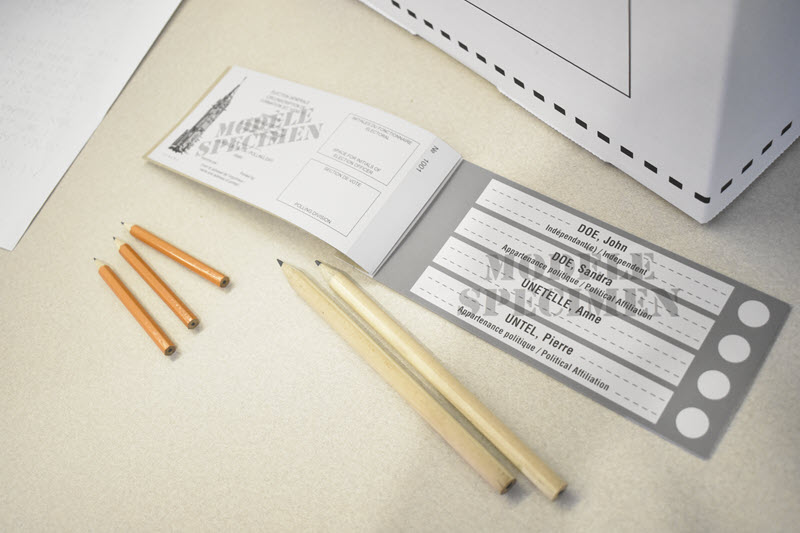
The names of candidates are listed on the ballots in alphabetical order. Each candidate's political affiliation is shown under their name, unless they choose to have "independent" or no affiliation appear instead. Electors take their ballot behind the voting screen and mark their ballot in the white circle beside their preferred candidate's name.
Special ballot
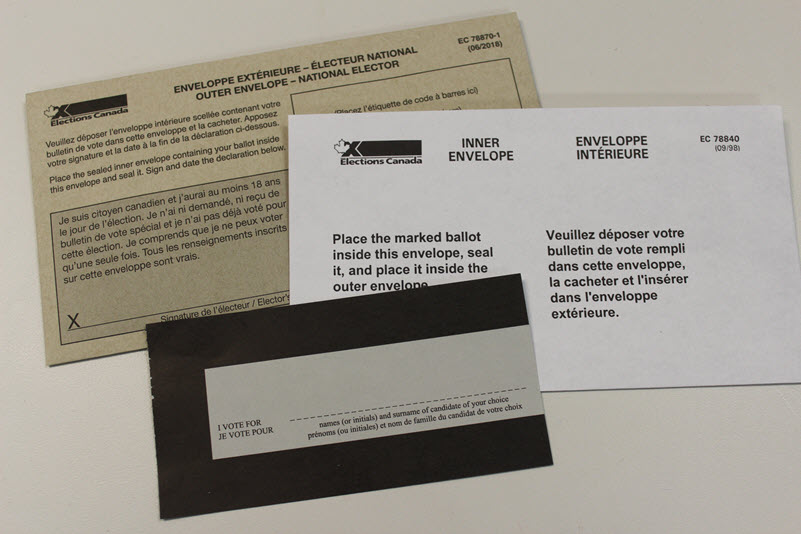
Electors voting by special ballot—whether by mail, at an Elections Canada office or by another method—fill out their ballot by writing the name of the candidate in their electoral district whom they are voting for. Electors must also complete and sign the declaration on the outer envelope. The declaration states that they have not already voted and will not attempt to vote again in the current election.
Following the instructions provided, electors place their ballot in the inner envelope and then place the inner envelope in the outer envelope.
For more information, see: Special ballot .
Accessible voting
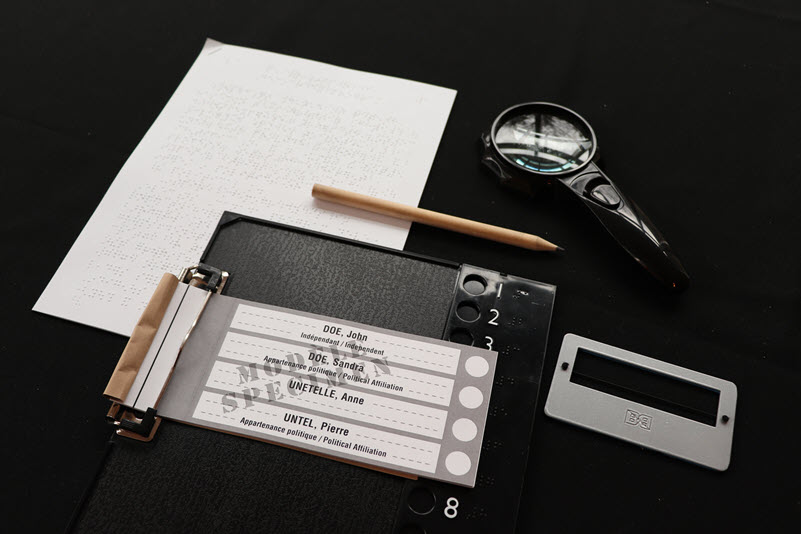
Elections Canada offers many tools and services to make voting easier for persons with disabilities.
Large-print and braille lists of candidates, tactile and braille voting templates, magnifiers and large-grip pencils are available at polling stations.
Electors may also ask for help in marking their ballot or proving their identity. They can also request language and sign language interpretation services ahead of time.
For more information, see: Accessible voting .
Video: Voting assistance tools and services on election day
Text version of "Voting assistance tools and services on election day"
Visual: "Federal Election" appears. Fades to black.
Narrator: Federal election. Elections Canada offers many tools and services to make voting accessible.
Super: Voting assistance tools and services on election day
Visual: Title and Elections Canada logo.
Narrator: If you need assistance during the voting process, we're happy to help.
Visual: Title card fades. Desk with poll worker behind a plexiglass shield appears. Poll worker is wearing a face mask and waving an election ballot.
Super: If you need assistance, we're happy to help
Visual: Worker disappears as desk morphs into back of voting screen with an X on it. Two people wearing face masks are behind the screen, one is a voter, the other a poll worker who is helping.
Narrator: There are a number of tools and services available when you go to vote on election day:
Super: Many tools and services are available on election day
Visual: The two people disappear, as desk morphs into a bigger ballot.
Narrator: Bigger ballot with candidate names in large print
Super: Bigger ballot
Visual: Bigger ballot morphs into braille list of candidates.
Narrator: Large-print and braille lists of candidates
Super: Large-print and braille lists of candidates
Visual: Braille list of candidates morphs into tactile and braille voting template.
Narrator: Tactile and braille voting template
Super: Tactile and braille voting template
Visual: Tactile and braille voting template morphs into magnifier.
Narrator: Magnifiers
Super: 4X magnifiers
Visual: Magnifier morphs into large-grip pencil.
Narrator: Large-grip pencils
Super: Large-grip pencils
Visual: Large-grip pencil morphs into two hands signing, and a talk bubble with Roman and Chinese character.
Narrator: We also offer language or sign language interpretation upon request. If you need interpretation services, call us at 1-800-463-6868 or TTY 1-800-361-8935 before the Tuesday before election day, 6:00 p.m.
Super: Language or sign language interpretation. Call us at 1-800-463-6868 or TTY 1 800-361-8935 before the Tuesday before election day, 6:00 p.m.
Visual: Signing hands and talk bubble morph into back of voting screen with an X on it. Two people are wearing face masks behind the screen; one is a voter, the other a poll worker who is helping.
Narrator: If you need assistance marking your ballot, you can bring someone you know or ask an election worker to help you.
Super: We're here to help
Visual: Scene morphs back to two hands signing, and a talk bubble with Roman and Chinese characters.
Narrator: Our website is fully accessible and has voting information in multiple languages.
Super: Other languages and formats
Visual: Signing hands and talk bubble morph into iconographic laptop computer displaying the elections.ca landing page, which then morphs into speaker symbol with sound waves.
Narrator: There are also products available in many other formats, including large print, braille and audio.
Super: Other languages and formats
Visual: Speaker morphs to back of iconographic laptop. The letter i (for information) is on back of computer. A person is looking at the screen and talking on the phone.
Narrator: If these options don't meet your accessibility needs, call us to discuss other ways you may be able to vote.
Super: Call for more options – 1-800-463-6868 or TTY 1-800-361-8935
Visual: The screen changes to a coloured background with text.
Narrator: Visit elections.ca for the official information on voting and the health and safety measures in place
Super: elections.ca – Get the official information on voting and the health and safety measures in place
Narrator: or call 1-800-463-6868. TTY 1-800-361-8935.
Visual: Fades to black. A large X appears with the campaign tagline "It's Our Vote". The tagline fades while the X flies off to settle into the X in the Elections Canada logo that appears on screen. The URL elections.ca appears on screen, followed by the toll-free number 1-800-463-6868 and the TTY number 1-800-361-8935.
Super: X It's Our Vote
Super: Elections Canada logo – elections.ca – 1-800-463-6868 – TTY 1-800-361-8935